The 2028 Republican Nomination: An Analysis of Marco Rubio’s Strategic Positioning, Ideological Realignment, and Electoral Prospects
The Vatican Clash: Navigating Factional Divides
The prominence of Catholicism within the administration’s upper echelons—both Rubio and Vance are devout Catholics—has also exposed deep internal fractures within the conservative movement. These religious and political fault lines were violently exposed in early 2026 during an unprecedented diplomatic clash between President Trump and Pope Leo XIV.
Following a series of severe, highly personal public insults directed at the Pontiff by the President—in which Trump labeled the Pope “WEAK on crime” and “terrible on foreign policy”—the administration faced immense, organized backlash from Catholic voter coalitions that had been instrumental in delivering Trump’s recent electoral victories. Organizations like CatholicVote.org, led by Kelsey Reinhardt, demanded an immediate apology, condemning the breakdown in basic diplomatic decorum and calling a meme depicting Trump as Jesus “blasphemous”. Brian Burch, the American ambassador to the Holy See, was reportedly placed in a “really horrible position” by the diplomatic fallout.
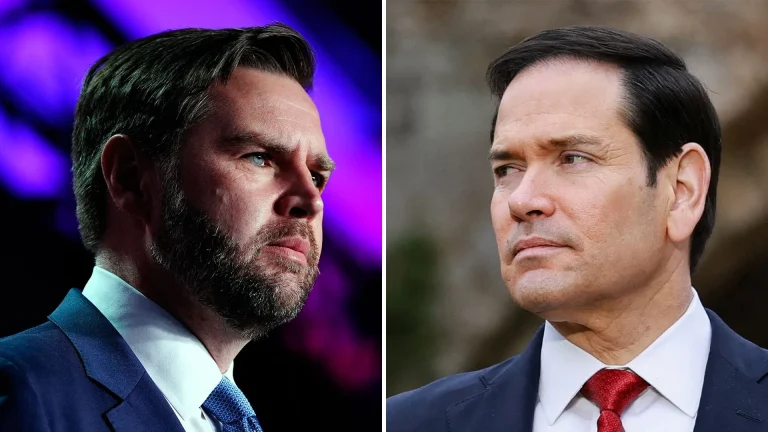
The administration’s response to this crisis highlighted the intense strategic rivalry between its two heirs apparent. Rather than Rubio—who, as Secretary of State, is the chief diplomat and a frequent Mass-goer—taking point on the crisis, President Trump explicitly chose Vice President JD Vance to publicly defend the administration’s remarks. Political observers immediately noted that Trump “wheeled out” Vance to “sweat in front of the cameras,” essentially forcing the Vice President to compromise his own deep reverence for papal authority in a brutal loyalty test to the President.
Throughout this geopolitical and spiritual crisis, Marco Rubio remained notably, strategically silent. By successfully avoiding the controversy entirely, Rubio preserved his standing with traditional, mass-going Catholic voters while simultaneously avoiding the political trap of explicitly rebuking the President. This highly calculated evasion underscores his political dexterity, allowing Vance to absorb the full collateral damage of Trump’s erratic behavior while Rubio maintained an aura of unbothered diplomatic professionalism.
Demographic Restructuring: Immigration Enforcement and the Hispanic Realignment
A central pillar of the modern Republican coalition is the accelerating rightward shift among Hispanic and Latino voters, a demographic realignment that fundamentally alters the electoral calculus for 2028. As the highest-ranking Hispanic official in U.S. history, Marco Rubio possesses an intrinsic, structural advantage in consolidating and expanding these vital electoral gains.
The 2024 Catalyst and the Shifting Latino Electorate
The 2024 presidential election served as a profound watershed moment for Hispanic conservatism. Polling and exit data revealed that Donald Trump won approximately 43% of the overall Latino vote, representing a staggering eight-point increase from his 2020 performance. The shift was particularly pronounced among young Latino men under the age of 40, 48% of whom supported Trump. Fully 20% of these young male supporters were first-time voters, driven heavily by immediate economic concerns, the rising cost of living, and an explicit rejection of progressive cultural messaging.
This rightward drift occurred despite controversies, such as the September 2024 presidential debate where Donald Trump amplified false news stories regarding Haitian immigrants in Ohio—demonstrating that economic anxieties heavily outweighed concerns over racially charged rhetoric for many working-class Latino voters. Despite these gains, the Latino electorate remains complex and stubbornly non-monolithic. While conservative shifts are evident, a September 2026 Pew Research survey found that on a national level, generic Democratic candidates still hold an advantage over Republicans among Latinos (57% to 39% for Vice President Kamala Harris in a hypothetical matchup). However, the margins are rapidly narrowing, and the voting bloc wields outsized, decisive influence in critical sunbelt swing states such as Arizona, Nevada, and Georgia.
Executive Actions on Immigration and Border Security
Rubio’s strategy to capture and solidify this demographic relies on leaning heavily into enforcement-focused immigration policies, explicitly rejecting the outdated conventional wisdom that Hispanic voters universally favor lenient border enforcement. Rubio has been unambiguous in his rhetoric, stating plainly to the press that “Hispanic voters are not in favor of illegal immigration”. This strict alignment with the border policies of the Trump administration resonates strongly with naturalized citizens and multi-generational Hispanic voters in states like Florida and Texas, who increasingly view unchecked illegal immigration as a direct economic and security threat to their own communities.
Crucially, Rubio has not merely rhetorically supported strict immigration policies; he has aggressively wielded the regulatory power of the State Department to enact them. In March 2025, Rubio issued a sweeping and highly controversial determination declaring that all federal efforts related to border control, immigration, and cross-border transactions fall permanently under the “foreign affairs function exemption” of the Administrative Procedure Act (APA). This unprecedented move effectively bypassed the standard, time-consuming public notice-and-comment periods typically required for federal rulemaking, granting the administration the power to rapidly and unilaterally implement stringent immigration protocols without public interference.
Furthermore, Rubio utilized his authority under INA 212(a)(3)(C) to implement aggressive new visa restriction policies aimed directly at the facilitation of illegal migration. On March 5, 2025, he announced targeted exclusions against foreign government officials—specifically including foreign customs, airport, and port authority personnel—who knowingly facilitated illegal migration to the United States’ southwest border. In a further tightening of the student visa system, the Department of State updated 9 FAM 402.5 regarding F, M, and J visas, adding strict new requirements that F-1 students must demonstrate an intent to solely pursue a full course of study, severely limiting backdoor immigration avenues.
These executive actions serve a potent dual purpose. From a policy perspective, they align perfectly with the administration’s core directive to secure the border. From a political perspective, they establish an ironclad, concrete record of enforcement that completely insulates Rubio from potential attacks by hardline nativists within the GOP primary base, proving that a Hispanic candidate can be an uncompromising, ruthless enforcer of national sovereignty.