The 2028 Republican Nomination: An Analysis of Marco Rubio’s Strategic Positioning, Ideological Realignment, and Electoral Prospects
The 2026 Midterm Threat and Structural Openings
Perhaps the most crucial exogenous variable affecting Rubio’s 2028 chances is the impending 2026 midterm elections. The Interactive Brokers Forecast Trader market indicates a staggering 85% probability that the Democratic Party will seize control of the US House of Representatives in November 2026, leaving the Republicans with only a 15% chance of retaining power.
This predictive data aligns with the Yale Youth Poll, which found Democrats leading the 2026 generic ballot by 2 points overall, with massive leads among younger demographics (D+23 for ages 18-22; D+30 for ages 23-29). Young voters are vehemently opposing the administration, driven by overwhelming concerns regarding the cost of living (84%), healthcare (75%), and deep skepticism toward Artificial Intelligence and executive overreach. Furthermore, 50% of voters support eliminating or severely reducing funding for Immigration and Customs Enforcement (ICE).
If a Democratic wave materializes in 2026, resulting in the loss of the House, it will profoundly alter the 2028 Republican primary dynamics. A devastating midterm loss would be interpreted as a direct referendum on the Trump-Vance populist agenda. This structural collapse would instantly validate Rubio’s underlying argument: that the party requires a competent, experienced institutionalist who can maintain the America First policy framework while projecting an aura of stability necessary to win back the suburban and independent voters repelled by Vance’s abrasive populism.
Furthermore, Rubio will be monitoring the highly fragmented 2028 Democratic primary field, where Kamala Harris (20%), Gavin Newsom (19%), Pete Buttigieg (14%), and Alexandria Ocasio-Cortez (13%) are locked in a generational battle. Young Democrats heavily favor progressive policies (56%) and candidates like AOC, while seniors favor Newsom. A fractured, left-leaning Democratic ticket would provide the perfect foil for Rubio’s “common-good capitalism” to appeal to moderate swing voters.
The Shadow Campaign: Infrastructure, Donors, and Plausible Deniability
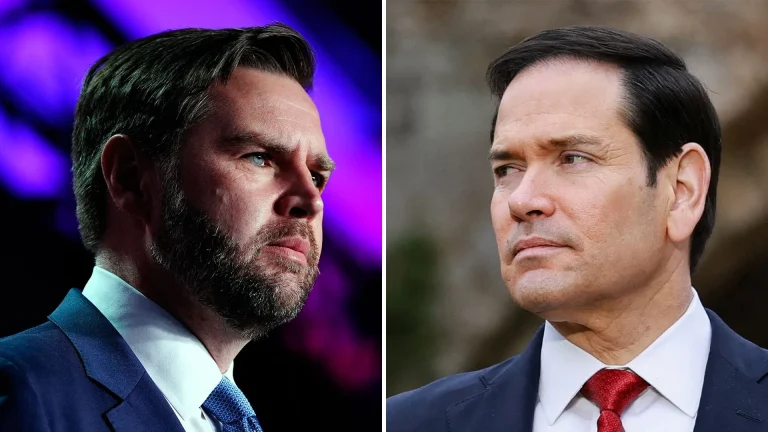
While Marco Rubio has publicly vowed not to challenge JD Vance for the 2028 nomination, veteran Republican operatives view this commitment as highly malleable—a calculated maneuver designed to avoid provoking the ire of a President known for demanding absolute loyalty. The reality on the ground is that a sophisticated, albeit quiet, shadow campaign infrastructure is already in place, waiting to be activated.
America 2100 and the Establishment Donor Class
The most visible mechanism for a potential Rubio presidential run is “America 2100,” a 501(c)(4) political nonprofit organization founded in 2023 by Mike Needham, Rubio’s top political counselor and former chief of staff. The group’s slogan—”Ensuring the next century is an American century”—deliberately echoes the optimistic messaging of Rubio’s 2016 presidential campaign.
While the organization has remained largely dormant since circulating videos in late 2024 to bolster the Trump-Vance ticket, it retains nearly $3 million in the bank according to recent IRS filings. More importantly than its current cash reserves is its immense structural utility. As a 501(c)(4) dark money group, America 2100 is not legally required to disclose its contributors. This provides a highly discreet, secure conduit for major GOP donors—particularly the Wall Street, tech, and corporate establishment figures who are increasingly alienated by JD Vance’s hostility toward corporate power—to park capital and quietly express their financial support for a Rubio alternative.
This institutional, dark-money approach stands in stark contrast to JD Vance’s reliance on the Rockbridge Network, a secretive donor group he co-founded in 2019 during his stint as a private investor, which held its recent spring summit behind closed doors in Nashville. The battle between America 2100 and the Rockbridge Network represents the financial proxy war mirroring the ideological Vance-Rubio divide. Should Vance falter under the weight of an unpopular Iran war, or should Trump’s endorsement become an open question following a 2026 midterm defeat, America 2100 serves as a fully operational, fully funded launchpad that can be activated instantly, allowing Rubio to bypass the traditional, sluggish early-campaign fundraising phases.