
Virginia voters approve a map giving Democrats a chance at four more House seats
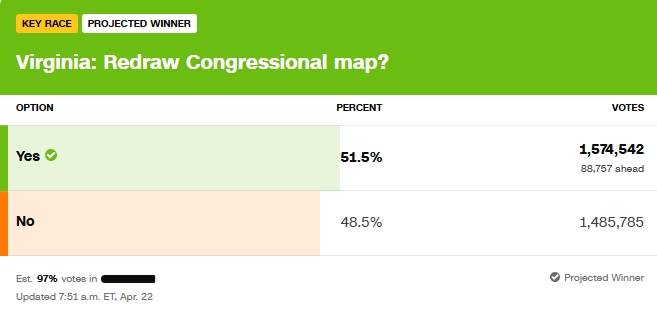
Virginia voters approved a map that gives Democrats the chance to net as many as four US House seats in a major boost to the party’s effort to win House control in the midterms.
The map set to go into effect represents one of the most extreme political gerrymanders of the 2026 election cycle, giving Democrats an electoral advantage in 10 of the state’s 11 House districts. Currently, Democrats control six of those seats.
Tuesday’s referendum drew a multimillion-dollar campaign to persuade Virginians to alter the state constitution to temporarily allow lines crafted by the state’s Democratic-controlled legislature to govern the election this fall, in 2028 and in 2030.
Supporters of the map, led by national figures such as former President Barack Obama and House Democratic Leader Hakeem Jeffries, cast the change as necessary to serve as a check on President Donald Trump and Republican policies during his final two years in the White House. Trump launched the ongoing mid-decade redistricting battle last year when he pushed Texas Republicans to redraw their maps for GOP advantage.
House Speaker Mike Johnson and several former Virginia Republican officials, including former Gov. Glenn Youngkin, campaigned against Democrats’ redistricting actions in the state, as Republicans worked hard to mobilize conservatives in rural areas to oppose the map. Trump dialed into a call Monday night to mobilize opponents and posted Tuesday morning on his social media network: “VIRGINIA, VOTE ‘NO’ TO SAVE YOUR COUNTRY!”
“Virginia just kicked Donald Trump’s ass,” Virginia House Speaker Don Scott, one the leaders of the pro-map effort, told CNN Tuesday night. “We have rejected him in every state election where he has been anywhere close to the ballot.”
Scott argued Trump’s 11th-hour move to rally voters helped Democrats’ cause in the end. “All he did was wake Virginians up and let them understand the threat that he is.”
Virginia is the latest to engage in the once-rare practice of mid-decade redistricting as both political parties hunt for advantage ahead of November’s elections for Congress. Republicans hold a paper-thin majority in the House and face the headwinds of history: The president’s party typically loses ground in Congress in the midterms.
With Tuesday’s victory, Democrats have redrawn 10 seats nationally to their advantage since Texas kicked off mid-decade redistricting, compared to Republicans’ nine.
Democrats could flip 1 more seat than Republicans
Republicans have enacted new congressional maps in 4 states, targeting nine US House seats currently held by Democrats. New maps in California, Utah and Virginia could flip as many as ten seats for Democrats.

👉 Why it matters
The party not in the White House typically picks up seats in midterm elections. Republicans’ historically small margin in the House and a shrinking universe of competitive districts means that even a few seats could determine control of Congress next year.

The map’s proponents spent more than $56.4 million on advertising through Tuesday morning – more than twice the $24.6 million invested by groups opposed to the map, according to AdImpact, which tracks political advertising.
In a video message in the campaign’s final days, Obama said the new map would help “push back against the Republicans trying to give themselves an unfair advantage in the midterms.”
In a statement Tuesday night, Jeffries was blunt.
“Democrats did not step back,” he said. “We fought back. When they go low, we hit back hard.”
Republicans indicated they will continue to pursue legal challenges to the Virginia plan. One avenue is the state Supreme Court, which allowed Tuesday’s vote to go forward but is still weighing an appeal of a lower-court ruling that the referendum was invalid.
North Carolina Rep. Richard Hudson, the chairman of the House Republicans’ campaign arm, said the margin of victory – which appeared closer than recent Democratic wins in the state – “reinforces that Virginia is purple state that shouldn’t be represented by a severe partisan gerrymander.”
In interviews at polling places Tuesday, voters said they weren’t enthusiastic about redistricting but decided to support the map nonetheless.
John McIntire, an independent voter from Manassas in northern Virginia, said he’s “not a real fan of gerrymandering” but voted in favor of the referendum after Texas Republicans’ opening salvo in the redistricting fight last summer.
“If it’s being done by one party, it’s a problem. I think it shouldn’t happen at all,” McIntire said. “My concern is that it’s an unlevel playing field and this is trying to right it a little bit.”
The ‘No’ campaign ran ads for different audiences
One closing ad from the leading opposition group, Virginians for Fair Maps, distilled the message Republicans sought to send to rural Virginians and leaned into hot-button issues for conservatives. It showed AI-generated imagery of someone resembling the state’s newly installed Democratic Gov. Abigail Spanberger, smiling as she set fire to a barn. It claimed that Spanberger and Democrats wanted to “burn Virginia’s democracy to the ground” with the goal of increasing taxes, seizing guns and opening borders to undocumented immigrants.
In an effort to sway Black voters, opponents sought to characterize the new map as reducing the influence of African Americans. For instance, one ad from a group called Justice for Democracy featured video of Martin Luther King Jr.’s 1963 March on Washington and warned that the redistricting “dilutes the votes of historically marginalized communities.”
(The map shifts some Black and Hispanic voters in the Hampton Roads and Richmond communities into neighboring districts to make those areas more Democratic, but proponents rejected claims the change would weaken Black political power.)
The Virginia outcome represents a significant setback in the GOP’s redistricting campaign Trump set off last year by successfully encouraging Texas Republicans to draw five additional Republican-friendly seats. House district lines are typically drawn once every decade, following the Census, rather than in the middle of the 10-year period.
Democrats in California responded with a map that largely offset Texas’ move, and other states quickly joined the fray.
Vindication for state Democrats
In Virginia, Democrats debated internally about how many Republican seats to target with their new map, with some elected officials advocating going for a more modest eight or nine seats, rather than 10. Former Vice President Kamala Harris won Virginia in 2024 by less than 6 points.
But prominent figures in the party, led by the outspoken state Senate President Pro Tempore L. Louise Lucas, prevailed. Lucas spent months taunting Republicans with social media memes promoting the 10-1 map.
“Why would we go through all this for an 8-3 map?” she told CNN in a recent interview. “We’ve got to fight fire with fire.”
National Democrats say their aggressive response shows their party is willing to fight the president on his own terms.
“We have to be as aggressive, dare I say, ruthless, as they have been,” California Gov. Gavin Newsom said during a virtual event for the pro-redistricting campaign in Virginia. “We can’t win arguments anymore. We’ve got to win fights. And we’ve got to fight fire with fire.”
Newsom, who spearheaded the redistricting effort in his state, is term-limited and positioning himself as a potential 2028 presidential candidate.
Spanberger emphasized on Wednesday, however, that the redistricting effort is temporary.
“Our goal should be that when we no longer have a reckless president who just believes he’s entitled to congressional seats, that we will ensure that, that Virginia leads the way in going back to our redistricting commission, as the amendment that we passed yesterday calls on us to do,” the Virginia governor told MS NOW.
Florida could be the next battleground
Trump, who lost all three of his presidential bids in the state, had been notably absent from any public-facing role in the GOP effort until joining Johnson for an election-eve tele-rally to urge Virginians to vote “no.”
“This is really a country election,” Trump said during the event, underscoring the significance of Tuesday’s results in the national redistricting fight. “The whole country is watching; it’s so important and so unfair what they’ve done.”
Despite Democrats’ victory, Virginia voters may not have the last word on redistricting.
Next week, Florida’s Republican-controlled legislature is slated to meet in a special session called by GOP Gov. Ron DeSantis to consider new US House maps. Republicans have not yet released a specific plan, but some have indicated an interest in targeting as many as five seats now held by Democrats.
The Florida effort faces several obstacles of its own.
The state’s constitution prohibits gerrymandering on partisan grounds. And some Florida Republicans in Congress have publicly warned that an aggressive redraw could endanger GOP incumbents. They’ve taken note of unexpected Democratic wins in special elections, including in a deep-red district that includes Trump’s home of Mar-a-Lago.
This story has been updated with additional details.